
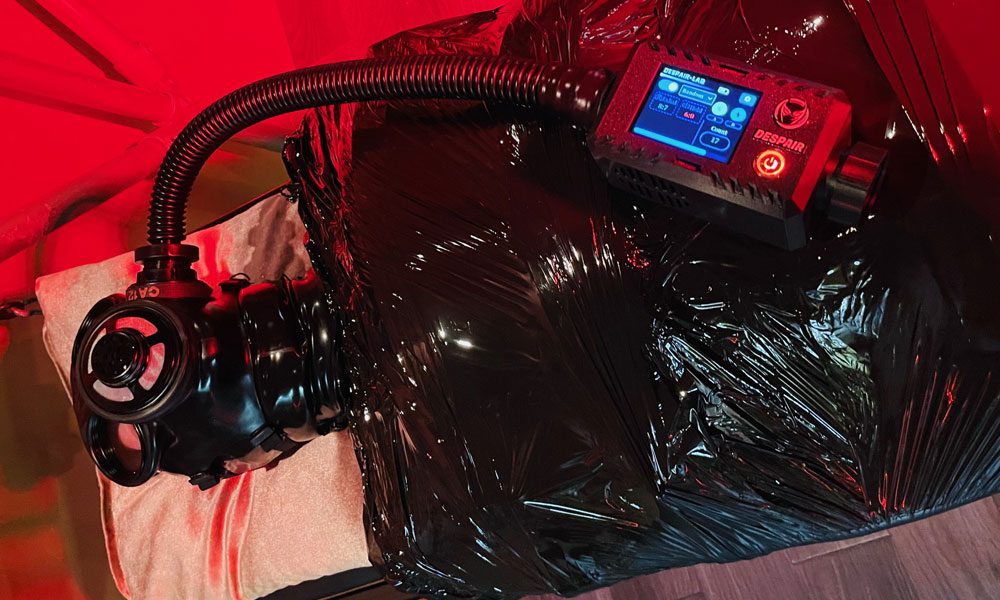
Breathplay sits among the highest-risk activities that can appear in professional domination. A request for it often arrives with strong curiosity or fantasy, yet the physiological realities make it fundamentally different from impact play, bondage or psychological control. Any professional mistress or dominatrix who takes safety seriously treats breathplay as edge activity that demands rigorous screening, clear expectations and the willingness to decline when conditions are not met.
This is not theatre. Oxygen restriction and interference with blood flow to the brain carry consequences that cannot be fully controlled. Understanding those risks, and the professional response to them, protects everyone involved.
Why Breathplay Carries Irreducible Risk
The human body does not tolerate interruption of oxygen or cerebral blood flow gracefully. Even brief restriction can trigger cardiac arrhythmia, loss of consciousness, stroke or permanent brain injury. These outcomes are not theoretical. They occur in healthy people, with experienced partners, and sometimes without obvious warning signs. Recovery is not guaranteed simply because the restriction ends.
Medical and community consensus is clear: there is no technique, duration limit or safety protocol that reduces the risk to zero. Experience does not eliminate it. Sobriety helps but does not guarantee safety. The same activity that produces euphoria for one person can produce catastrophe for another, sometimes in the same session. Cumulative effects from repeated exposure add a further layer of uncertainty.
Legal realities compound the danger. In many jurisdictions, consent does not provide a complete defence if serious injury or death occurs. A dominatrix who engages in breathplay accepts potential professional, financial and criminal exposure that simply does not exist with lower-risk forms of play. This is one reason many experienced professionals either refuse the activity outright or place it behind the strictest possible gates.
It Is Never Casual
Casual requests for breathplay are a red flag. The activity cannot be added mid-session on a whim, nor can it be treated as an optional extra once the deposit is paid. It requires advance disclosure, medical transparency and mutual acceptance of residual risk. A professional mistress will not improvise it. She will not accept “just a little” as a negotiation position. She will not continue if the submissive appears impaired by alcohol, drugs or fatigue.
The power dynamic itself changes the calculus. In a professional session the dominatrix holds responsibility for the physical welfare of the person in her care. That responsibility becomes heavier when the activity can produce unconsciousness or cardiac events within seconds. Ethical practice therefore demands that the activity, if offered at all, is approached with the same seriousness as any other high-stakes edgeplay: planned, limited, monitored and stopped the moment any concern arises.
Many providers maintain a hard limit against breathplay for precisely these reasons. Others will consider only the lightest, most controlled expressions under tightly defined conditions. Either stance is professional. Neither is personal rejection.
How Professional Screening Works
Screening for breathplay is more thorough than for most other activities. A competent dominatrix will expect full disclosure of relevant medical history before any discussion of the scene itself. This includes cardiac conditions, respiratory issues, previous loss of consciousness, blood-pressure problems, neurological history, medications and any prior adverse reactions to oxygen restriction or neck pressure. Incomplete answers or reluctance to provide them usually end the conversation.
Experience level is examined carefully. Someone who has only seen breathplay in media or who cannot articulate what they are actually seeking is unlikely to be accepted. The professional needs to know whether the interest is psychological (control, vulnerability, helplessness) or physiological (the physical sensations of restricted breathing). Vague or purely porn-inspired requests are often declined because they indicate insufficient risk awareness.
Sobriety is non-negotiable. Intoxication of any kind multiplies danger and is an automatic refusal. The same applies to combining breathplay with heavy restraint, gags or positions that could compromise recovery if consciousness is lost. A professional will state these boundaries clearly in advance.
Safewords and non-verbal signals are established, yet both parties must understand their limitations. Once oxygen is restricted, the ability to use a verbal safeword can disappear. This is why many professionals insist on continuous visual and physical monitoring and maintain the right to stop the activity unilaterally at any moment.
Aftercare expectations are also discussed. The submissive may feel disoriented, emotional or physically depleted. The dominatrix needs to know what support will be required and whether the person has a safe way to travel afterwards.
Reasons a Request May Be Declined
A request for breathplay can be declined for many legitimate reasons. Medical history that raises risk is the most common. Any cardiac, respiratory or neurological concern is usually sufficient grounds for refusal. So is a history of fainting, panic attacks under restraint, or previous negative experiences with oxygen restriction.
Lack of clear communication or an inability to discuss the activity outside fantasy language often leads to a polite no. Professionals look for adults who can step out of role long enough to talk about physiology, limits and emergency planning. Those who treat the conversation as part of the scene, or who become defensive when safety questions are asked, are not suitable candidates.
The dominatrix’s own limits and insurance position matter. Some providers simply do not offer breathplay under any circumstances. Others restrict it to established clients with proven trust and documented health information. A first-time visitor requesting intensive breath control is frequently declined regardless of how polite the enquiry is.
Pushiness after an initial no is another common reason for permanent refusal. Professional relationships depend on respect for stated boundaries. Attempting to renegotiate a hard limit signals that the person may not respect other limits once the session begins.
What This Means for Booking a Session
Anyone considering breathplay with a professional mistress or dominatrix should expect a longer, more detailed screening process than for other activities. Full honesty about health and experience is essential. The answer may still be no, and that answer should be accepted without argument.
When the activity is accepted, it will be tightly framed: limited duration, continuous monitoring, clear stop conditions and no improvisation. The dominatrix remains free to end it at any point. That control is not optional; it is the minimum requirement for responsible practice.
Breathplay is not a casual addition to a session. It is a high-risk activity that can only be approached, if at all, with full recognition of its dangers, thorough professional screening and the willingness of both parties to prioritise safety over fantasy. A competent dominatrix will always choose the former.